
Environmental compliance becomes more complicated for companies doing business internationally, as well as when doing business in other states. In this blog, we look at two states (Minnesota and California) that have passed laws that affect companies that are not necessarily operating within the state borders. These laws impose obligations on companies whose products are sold in those states, regardless of where the products are manufactured.
Minnesota – Information Gathering and Prohibitions
The state of Minnesota has been at the epicenter of per- and polyfluoroalkyl substances (PFAS) related issues. In 2018, 3M agreed to pay $850 million to settle a PFAS lawsuit with the state of Minnesota. Subsequently, 3M has agreed to billion-dollar settlements with other litigants.
Minnesota’s new law, Amara’s Law (Minnesota Statute Section 116.943), applies to products distributed or sold in the state and has two functions: gathering information and establishing prohibitions.
Required PFAS Information
The requirements in the law were delayed, but now the initial reports on PFAS in products distributed or sold in Minnesota are due on September 15, 2026.
According to Winthrop & Weinstine, “The law also allows the Minnesota Pollution Control Agency (MPCA) to gather information about PFAS usage through a new reporting requirement. Manufacturers are required to submit an initial report to the MPCA listing their products offered for sale, sold, or distributed in Minnesota that contain intentionally added PFAS.” Of note, the Amara’s Law definition of PFAS is very broad and includes many compounds not defined as PFAS under other regulations.
A manufacturer of a product sold, offered for sale, or distributed in the state that contains intentionally added PFAS must submit information to the commissioner that includes:
- A brief description of the product, including a universal product code (UPC), stock keeping unit (SKU), or other numeric code assigned to the product.
- The purpose for which PFAS are used in the product, including in any product components.
- The amount of each PFAS, identified by its Chemical Abstracts Service registry number, in the product, reported as an exact quantity determined by using commercially available analytical methods or as falling within a range approved for reporting purposes by the commissioner.
- The name and address of the manufacturer and the name, address, and phone number of a contact person for the manufacturer.
- Any additional information requested by the commissioner as necessary to implement the requirements of this section.
Potential penalties for noncompliance can be up to $25,000 per violation. The law includes some exceptions and conditions that allow waivers/extensions. The reporting will be done through the state’s PFAS Reporting Information System for Manufacturers (PRISM).
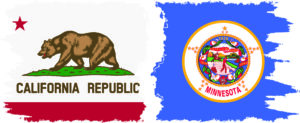
These laws impose obligations on companies whose products are sold in those states, regardless of where the products are manufactured (Image purchased from Shutterstock).
PFAS Prohibitions
As provided in the statute, as of January 1, 2025, “a person may not sell, offer for sale, or distribute for sale in this state the following products if the product contains intentionally added PFAS.”
This applies to the following 11 categories
- Carpets or rugs
- Cleaning products
- Cookware
- Cosmetics
- Dental floss
- Fabric treatments
- Juvenile products
- Menstruation products
- Textile furnishings
- Ski wax
- Upholstered furniture
While the ban began in 2025, on January 1, 2032, it will extend to any products with intentionally added PFAS.
For more information on PFAS, see our PFAS Resources page.
California – Climate Reporting Laws
California has enacted two “first-of-their-kind” climate disclosure laws: SB 255 (Climate Corporate Data Accountability Act) and SB 261 (Climate-Related Financial Risks).
SB 253 – Climate Corporate Data Accountability Act
SB 253 requires US entities with annual revenue over $1 billion that do business in California (subject to certain exemptions) to report their Scope 1 and Scope 2 emissions in 2026 and Scope 3 emissions beginning in 2027. The initial reporting deadline is August 10, 2026, and will become an annual requirement.
Scope 1 Emissions are direct greenhouse (GHG) emissions that occur from sources that are controlled or owned by an organization (e.g., emissions associated with fuel combustion in boilers, furnaces, vehicles).
Scope 2 Emissions are indirect GHG emissions associated with the purchase of electricity, steam, heat, or cooling. Although Scope 2 emissions physically occur at the facility where they are generated, they are accounted for in an organization’s GHG inventory because they are a result of the organization’s energy use.
Scope 3 Emissions are the result of activities from assets not owned or controlled by the reporting organization but that the organization indirectly impacts in its value chain. This includes GHG emissions from purchased goods and services, fuel and energy use, transportation, generated waste, business travel, employee commuting, and more.
(Source: USEPA).
Scope 3 Emissions have often been controversial as they can be difficult to accurately quantify and place responsibility on companies for emissions outside of their control. If your company supplies to a company that is required to report under this regulation, it is likely that future contracts will require reporting of GHG emissions to the purchaser.
According to Baker Donelson, “California will require that an independent third-party assurance provider conduct an assurance assessment to offer an independent opinion on the reports issued in accordance with the reporting rules.”
For more information, see the California Air Resources Board (CARB) website.
SB 261- Climate-Related Financial Risks
SB 261 applies to US entities with annual revenue over $500 million that do business in California (subject to certain exemptions).
SB 261 requires climate-related financial risk disclosures aligned with the Task Force on Climate-Related Financial Disclosures (TCFD) or equivalent frameworks. The actual timing is uncertain due to ongoing litigation.
On November 18, 2025, the Ninth Circuit Court of Appeals issued an order in Chamber of Commerce v. Sanchez, Case No. 25-5327 (9th Cir. 2025), granting an injunction against the enforcement of SB 261. See the notice by the CARB. Also see the US Chamber of Commerce.
While SB 261 is currently stayed, the law will require biennial (every-other-year) public reporting on climate-related financial risks and mitigation strategies for entities with over $500,000 in annual revenue.
According to a blog by Winston & Strawn, “CARB has indicated that with respect to this first report under SB 261 (January 1, 2026), it will consider good-faith compliance efforts and the timing of those efforts, which may be relevant if the law is ultimately allowed to move forward without providing additional time to comply.”
Environmental Assistance
If these state laws potentially affect your company, you may want to have a discussion with your legal counsel.
Dragun can assist you with environmental compliance, PFAS assessment/remediation, peer reviews, litigation support, and more. For more information or assistance, contact our office at 248-932-0228.
Alan Hahn drafted this blog. Alan has an undergraduate degree in Environmental Studies and completed a graduate program in Environmental Management. He has worked in environmental management for more than 45 years. He has written hundreds of blogs and articles. His published work includes Michigan Lawyers Weekly, Detroiter, Michigan Forward, GreenStone Partners, Manure Manager Magazine, Progressive Dairy, and HazMat Magazine.
This blog was reviewed by Matthew Schroeder, M.S., P.E. Matt is a senior environmental engineer at Dragun Corporation. Matt has advised industrial, commercial, municipal, and agricultural clients on environmental compliance for over 30 years. Matt has defended violations under RCRA, SARA, CWA, and NPDES; prepared, reviewed, and implemented numerous emergency plans; and advised on discharge permitting compliance for a wide variety of industries. Matt is a frequent speaker, author, and expert witness. See Matt’s bio.
Follow Dragun Corporation on LinkedIn, X, or Facebook.
Sign up for our monthly environmental newsletter.
Principled Foundation | Thoughtful Advice | Smart Solutions
Established in 1988